


OBJECT ORIENTED PROGRAMMING
Object-oriented programming (OOP) is a paradigm for defining software objects that interact
by exchanging messages.
Data-Ware applies object-oriented design and programming principles, using the most widely adopted
modeling techniques and languages such as UML.


OBJECTS
Development.
Efficient programming.
Among main advantages, Object Oriented Programming:
• provides a natural support for real-world object modeling software or the abstract model to reproduce
• allows easier management and maintenance of large projects
• code organizing in classes encourages modularity and code reuse
Features.
Classes.
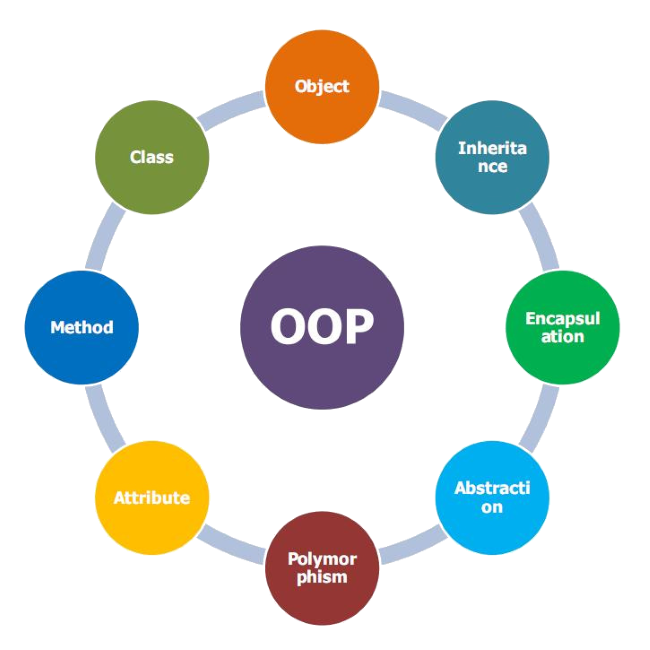
Classes, are the functional units of Object Oriented programming and constitute abstract models,
are invoked at run time to instantiate or create software objects.
The latter have attributes (data) and methods (procedures) as defined / declared by the respective classes.
A programming language is defined as objects when it allows to implement three mechanisms:
• encapsulation: consists of separating the so-called interface of a class from the corresponding implementation,
so that clients of an object in that class can use the first, but not the second.
• inheritance: essentially defines classes from other ones already defined.
• polymorphism: lets you write a client that can use different class objects, but with the same common interface;
at execution time, that client will have different behaviors without first knowing the specific type of object being passed to it.
Development. Efficient programming.
Among main advantages, Object Oriented Programming:
• provides a natural support for real-world object modeling software or the abstract model to reproduce
• allows easier management and maintenance of large projects
• code organizing in classes encourages modularity and code reuse
Features. Classes.
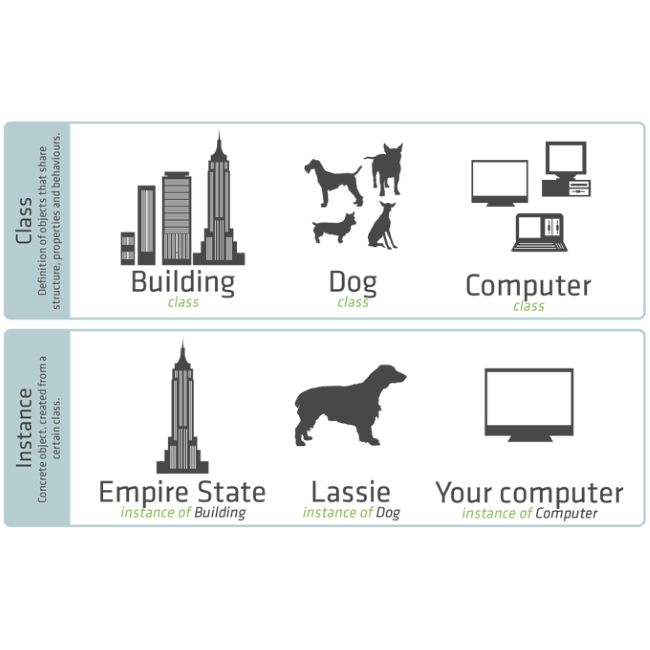
Classes, are the functional units of Object Oriented programming and constitute abstract models,
are invoked at run time to instantiate or create software objects.
The latter have attributes (data) and methods (procedures) as defined / declared by the respective classes.
A programming language is defined as objects when it allows to implement three mechanisms:
• encapsulation: consists of separating the so-called interface of a class from the corresponding implementation,
so that clients of an object in that class can use the first, but not the second.
• inheritance: essentially defines classes from other ones already defined.
• polymorphism: lets you write a client that can use different class objects, but with the same common interface;
at execution time, that client will have different behaviors without first knowing the specific type of object being passed to it.