


 Java Base Programming Course
The Java Basic course offers the chance to learn one of the most widely used high-level languages:
Java SE in its latest version.
No prior knowledge is required; the course is also suitable for beginners.


COURSE FEATURES
Structure. Introduction.
Course offers all the skills needed to program in Java, with particular emphasis on class management,
objects and methods that are functional to creating applications.
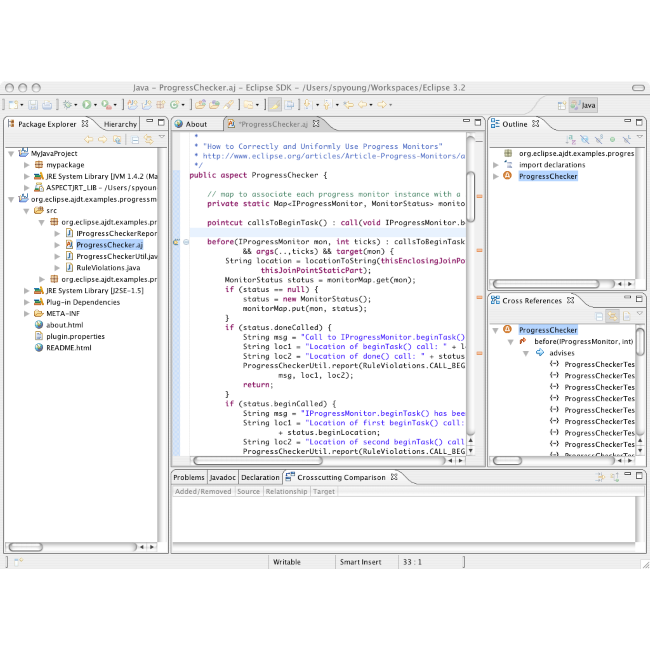
Programs you make will be equipped with graphical interfaces to make them work
usable, more intuitive by end users.
Participants will be guided in using advanced techniques such as database management, and networking.
First part. Basic programming concepts.
First part of course is crucial for those who never had experience in programming and / or in the
designing applications and using databases and providing basic knowledge to be able to access
to study of a real language.
Fundamentals and Logic of Programming, Database Design, SQL Language Syntax will be dealt with.

Second part. Programming basics in Java.
The second part of course focuses on programming in Java.
Among the most demanding languages from companies, for its multiple qualities, its portability and total adherence to principles
of Object Oriented Programming, Java is at the same time an excellent tool for learning
programming and its concepts.
At the end of course, which has the purpose of forming a full programmer, you will have all knowledge you need to be able to
complete complex and functional programs of medium complexity.
Schedule. Course detail.
FIRST PART
Fundamentals of Programming.
• What is Structured Programming?.
• What is an Algorithm?.
• Block Diagrams.
• Top-down and bottom-up programming.
• Variables, Constants and Data Types.
• Basic control structures: Sequence, Selection, Iteration.
• Arithmetic and Logic Operators.
• Pseudocode.
• Functions.
Database Designing.
• Introduction: data, data bases and DBMS.
• Structure in a relational database.
• Conceptual Design.
• Logic Design.
• Entity-Relationship Model.
• Relationships, Attributes, Tuple, Internal and External Keys.
• Normalization.
• Integrity constraints.
SQL Syntax Elements.
• Fundamentals of sql.
• SELECT statement (Select and From propositions).
• Proposition Where.
• Comparison Operators.
• Logical Operators.
• Proposition ORDER BY.
• JOIN and Grouping Functions.
SECOND PART
Introduction.
• Development environment installation.
• Introduction Java language.
• Compilation and execution.
• Java syntax.
Programming basics.
• Primitive data types.
• Particular case: the String class.
• Local variables.
• Casting.
• Assignment, Relational and Boolean Operators.
• Arithmetic operators.
• Pre / post increment and string concatenation.
• User Input/Output.
• One dimensional array.
• Multidimensional array.
• If-Else instruction and ternary operator.
• Nested If.
• Switch - case instruction.
• While cycle.
• Do-While cycle.
• For cycle.
• Nested cycles.
• Endless cycles.
• Labels, Break and Continue.
Methods.
• Main method and subroutine.
• Class methods: the Static keyword.
• Passing Parameters by Reference and Value.
• Modifiers.
• Management and import of packages.
• Scope of variables.
Object programming.
• Object programming.
• Designing a Class.
• Instantiate an object: the constructor.
• Instance variables and encapsulation.
• Visibility of members of a class.
• Reference This.
• Reserver keyword null.
• Static members and dynamic members.
Inheritance
• Concept of inheritance.
• Hereditary structures.
• From theory to practice: Inheritance.
• The super reserved word.
• The Object class.
• Prevent inheritance: reserved word final.
Polymorphism.
• Polymorphism.
• Overloading and Overriding.
• Dynamic binding.
• Casting with objects.
• Cast and instanceof.
Interfaces, abstract classes and grafted classes.
• Interfaces.
• Default method interfaces: definition and usage (Java 8).
• Static method interfaces: definition and usage (Java 8).
• Inheritance and polymorphism in interfaces.
• Abstract classes
• Engaged classes
• Anonymous classes
Exceptions
• Errors and exceptions
• Construct TRY-CATCH-FINALLY
• Exception types and the Throws construct
• Throw an exception: the Throw construct
• Custom Exceptions
Graphic programming
• Graphics Interfaces
• Netbeans Graphics Interfaces
• TextField and labels
• Buttons
• Tabbedpane

Teaching materials. All you need.
All necessary teaching materials will be provided, along with this course.
• Textbook / Dispensing Book
• Slides
• Examples
• Development tools
• Self-evaluation tests
