ICT INFRASTRUCTURE MANAGEMENT
Data-Ware delivers broad enterprise information-system integration: from custom interfaces that let applications
with different standards and platforms communicate, through to middleware that unifies the company's software
as completely as possible.


INTEGRATION
Experience. Our best value.
In recent years, the two main strategic initiatives undertaken by the companies concern the maintenance and evolution of the
existing applications (legacy applications) and the integration of systems first within the company and then also with external partners.
The main difficulty of these projects lies in the heterogeneity of the systems present within the company, and in the
resulting difficulties, in obtaining flexible and independent integration from platforms in use.
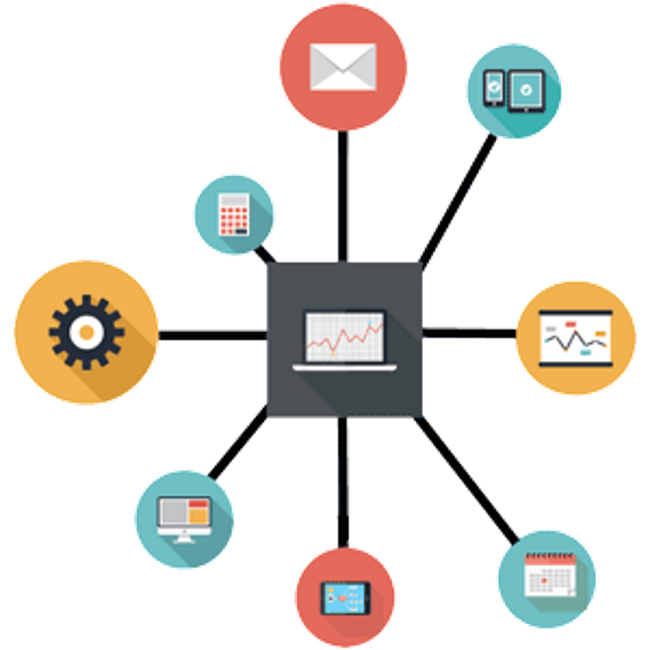
One of the dominant philosophies for integration is the creation of a "node of integration" or a middleware layer that represents
the adhesive between the various systems and it can be the only source for the processing of interest data and the subsequent display
of information through the Web.

Models. How to build integration systems.
There are two of the main models that enable the construction of integration systems:
RPC Model (Remote Procedure Call):
is the basis for almost all distributed processing platforms
(DCOM, CORBA, Java RMI); in view of the ease of implementation it requires tighter constraints on the client / server control regime,
data structures and transport protocols.
Web Services:
ie services offered on Web via XML that make it possible to build bridges between different systems using as
"Internet transport infrastructure".
The Web Services solution is rapidly emerging as a dominant model for both using open standards in the W3C
(World Wide Web Consortium) such as XML, WSDL (Web Services Description Language) and SOAP, and for the ability to "embed"
also the RPC model, and ultimately for extreme versatility.